introduction
OpenClaw is a vibe coded "personal assistant" that is currently at the peak of the Gartner hype cycle. Like all "AI evangelists", I wanted to give it a go to see if I can make it useful without giving it everything in my life. I didn't plan on using it as a developer team, but rather a more useful chatbot that I could use to replace Perplexity and other AI search+summary services.
I thought about setting up my own VPS to host OpenClaw on and pairing it with my existing Z.AI Coding Lite subscription that I bought before weekly limits were added. Around this time, multiple OpenClaw hosting services appeared out of thin air, offering OpenClaw hosted on managed infrastructure going from $5 a month with some hosting providers asking for much more.
I decided to give the KiloClaw beta a go - I was already using Kilo Code in my IDE and the Kilo Gateway meant that I wasn't locked into using a specific model.
After submitting the interest form, I got access to KiloClaw on the 19th of February.
the experience
Since this was a beta, I went in with lowered expectations as I was a test dummt. For the most part - the service was stable across the month that I used it. My hosted KiloClaw came with 2vCPU, 4GB RAM, and 10GB SSD storage included. Sufficient for OpenClaw and a few extras.
Initial setup was simple. Configuring a model was a breeze since the same Kilo Gateway used for Kilo Code was used for KiloClaw. The dashboard allowed configuration of the model and a Telegram channel. I configured Discord via the raw config file in OpenClaw (now exposed in the dashboard along with Slack).
There were simple controls to start, stop, and redeploy the instance. The OpenClaw version was fixed to a static version 2026.2.6 with no option to upgrade in the dashboard.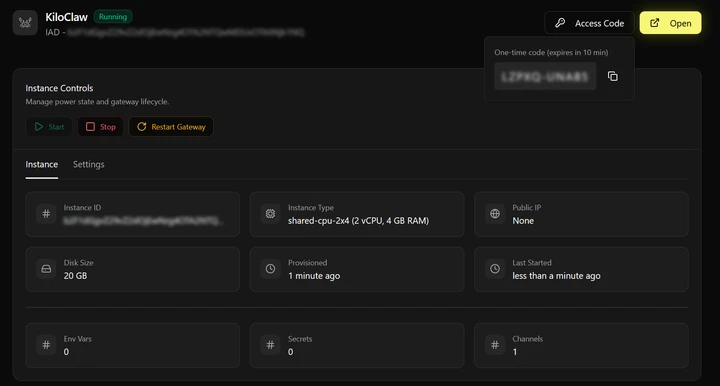
The points below are from the lens of someone that is comfortable managing their own server, and prefers to have full control rather than a stripped down experience.
the good
KiloClaw was incredibly easy to set up. While I would have been comfortable setting up OpenClaw on a VPS, using the managed service meant that I didn't need to think about service hardening, SSL certificates, and keeping the server up to date. I also didn't need to worry about noisy neighbours sharing the server resources as it was a dedicated fly.io instance for myself only.
Changing LLM models was also super simple - select a model from the dropdown list in the dashboard, apply, and you're away with a new model. This meant that I could identify the best model for my use case without collecting heaps of unused subscriptions.
The Kilo team were also quick to experiment; OpenClaw was running as a normal user one day, then root the next. It appeared that the engineering team had a lot to test and validate with new features rolling out in the dashboard every few days, whether it was additional channel configuration, plugin support, or direct edit access to OpenClaw files.
Access to the OpenClaw UI was also a breeze. There was an easy way to pair and connect to your instance, and everything including SSL certificates and tokens were automatically configured. Zero knowledge needed with the security of the UI outsourced to Kilo's infrastructure.
the not-so-good
Given that this was a beta service, I was expecting a lot more opportunities for feedback and direct support. I received exactly zero surveys or requests for feedback throughout the beta period. Communication was done via a Discord channel where support was mainly left to the beta testers to figure out. In-channel support only picked up towards the end of the beta phase when pricing was announced.
Installing Node/Python packages was also troublesome as they would not survive a restart. Upgrading KiloClaw? Lose all installed packages. Stop and Start KiloClaw? No packages for you. The workaround was to create a cron job that would perform the installation steps every hour to ensure packages didn't disappear. This was only fixed on the 17th of March and only on newly created instances.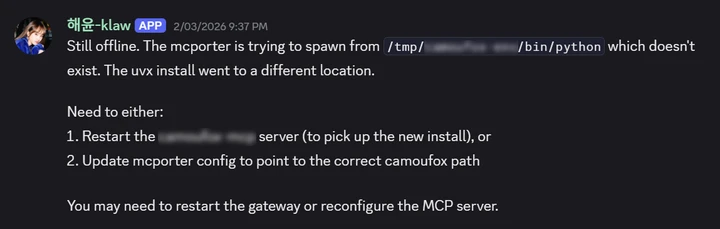
A large amount of tokens was burnt to set up MCP servers that weren't easily available on GitHub or as part of an existing skill. Sometimes the MCPorter configuration would persist while the MCP server was removed as part of a redeployment. Without an easy way to test MCP servers, it took way too long to triage and debug bad configurations.
the bad
Pricing is definitely a large drawback to any hosted OpenClaw service. Kilo haven't worked out how to set their prices, so it's all over the place:
- Initial pricing announcement: $49/m with an earlybird discount to $25/m for 100, then 1000 earlybird customer
- Trial countdown starts: Reduced to $25/m or $54/6mo
- Today: $9/m with the inital month for $4 or $48/6mo
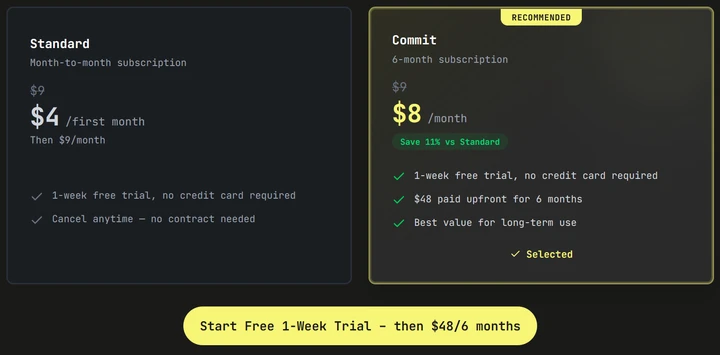
The prices dropping aren't bad. The lack of communication on price changes is. I posted about the $49/m price in their Discord channel before it was announced. The change to $9 hasn't been announced in their Discord, nor their blog post.
Access, configuration and control of the instance was also very tough. Any changes to the openclaw.json configuration would be reset every upgrade or restart and a lack of SSH access meant that installing linux packages would take longer than required. I spent way too much time in the OpenClaw UI chat running bash commands to install and configure packages.
where i landed
I self-hosted. After the KiloClaw free trial ended, I didn't want to pay $25/m (now less) for what still felt like a very early beta experience.
I very quickly found out that a managed OpenClaw service was not for me. I moved to a VPS that gives me more control. This means I don't have to worry about packages disappearing or configuration resetting. I picked up a VPS for ~6USD/m that has 2 Cores and 6GB RAM with plenty of storage space. It took me about an hour to install Debian 13, nvm, uv, and all the Linux packages that I needed to get going on OpenClaw.
closing thoughts
Do I recommend KiloClaw? Maybe
KiloClaw for $9/m now presents decent value for users who either don't know how to manage their own VPS or don't have the time to. At this point in time, KiloClaw doesn't feel like it is ready for general access. I do want to give it a go again in the future, but only if there's more control in the dashboard. Something as simple as a file browser can make it much easier to manage files on the OpenClaw instance.